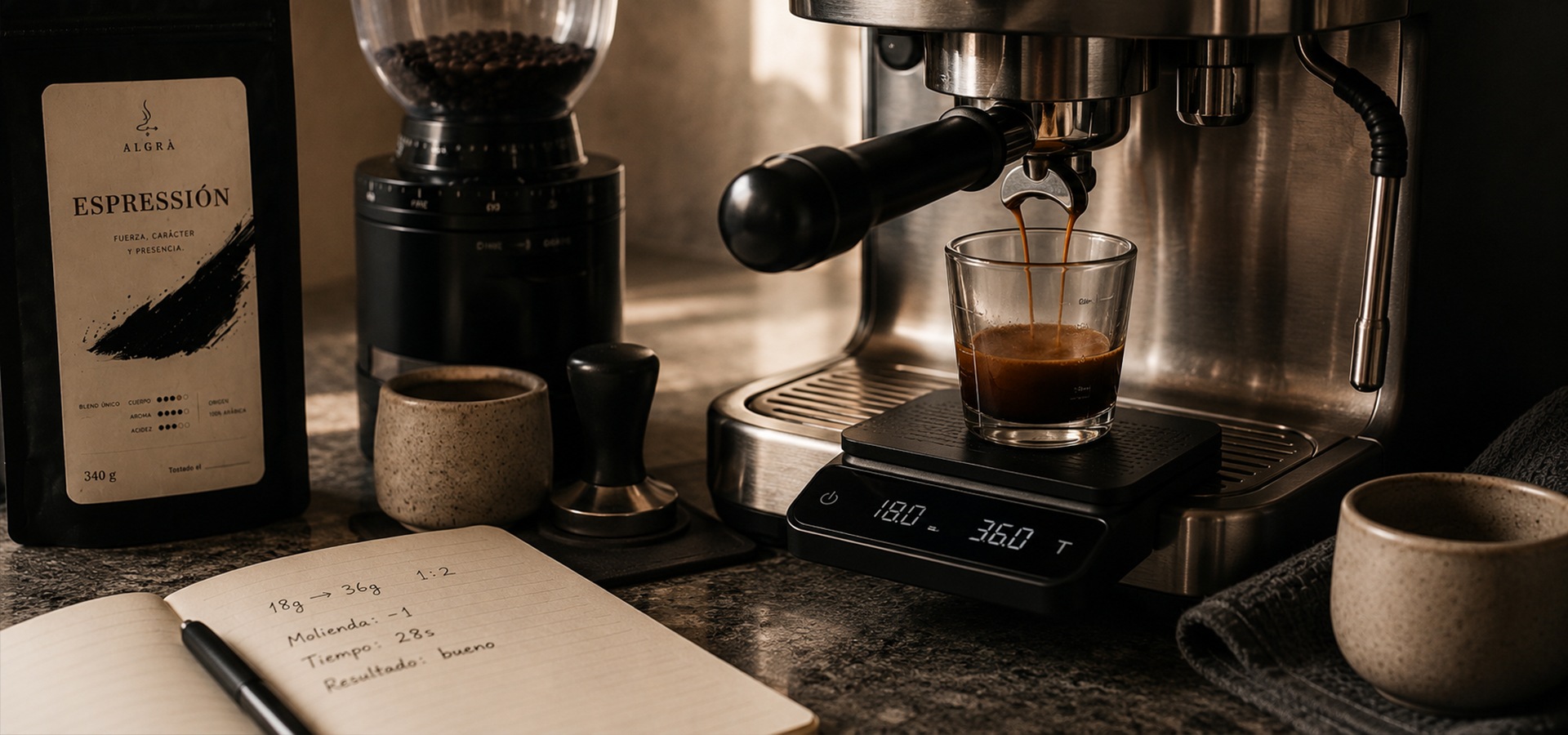
Grams, seconds, grind, scale... Which variables actually matter for a great home espresso, and which ones you can stop chasing.
Brewing espresso at home can quickly turn into a collection of numbers: grams, seconds, bars, temperature, grind, tamper pressure…
And after controlling all of that, the coffee can still taste off.
The reason is simple: not every variable matters equally. A great espresso isn't about hitting a universal recipe, but about finding a combination of coffee, grind, water amount and extraction that works on your machine and, above all, in your cup.
Start with the coffee and the grind
The machine matters, but it can't fix a coffee you don't like or an unsuitable grind.
In espresso, water passes through a compact bed of ground coffee in a very short time. The size and distribution of those particles determine the resistance the water meets and how extraction happens. Research on espresso has shown precisely that grind plays a fundamental role both in extraction and in the ability to repeat a result. Grinding extremely fine isn't always better either: it can cause uneven flow through the puck and produce less consistent extractions.
That's why, at home, a grinder that allows small adjustments can be more useful than chasing new machine features.
Weigh what goes in and what comes out
There's a surprisingly simple tool for improving espresso: a scale.
Say you use 18 grams of coffee and get 36 grams of beverage. You're brewing at roughly a 1:2 ratio. It's a common starting point, but not a rule every coffee must follow. The Specialty Coffee Association itself treats this ratio between ground coffee and final beverage as a particularly useful variable for understanding espresso.
Weighing it lets you know what you're actually changing.
If you brew 30 grams of espresso today and 45 tomorrow without noticing, comparing the two results becomes difficult. Keeping a known dose and yield lets you change just one variable afterward, grind for example, and observe what happens.
Time can serve as a reference, but taste should decide where the adjustment ends.
The machine matters. But its stability matters more
A good espresso machine must deliver water at a temperature and under conditions stable enough for the result to be repeatable. The SCA now has specific standards for both espresso machines and home grinders, precisely because equipment consistency is part of a controllable brew.
Water matters too. It's not just the medium passing through the coffee: its mineral composition affects extraction and the final perception of the drink.
But that doesn't mean brewing espresso at home has to become a lab experiment.
A coffee you like. An adjustable grinder. A known dose. Weighing your espresso. Changing one thing at a time.
That teaches you far more than chasing a recipe down to the second.
The best dial-in isn't the one that matches a number. It's the one you can repeat and want to drink again.