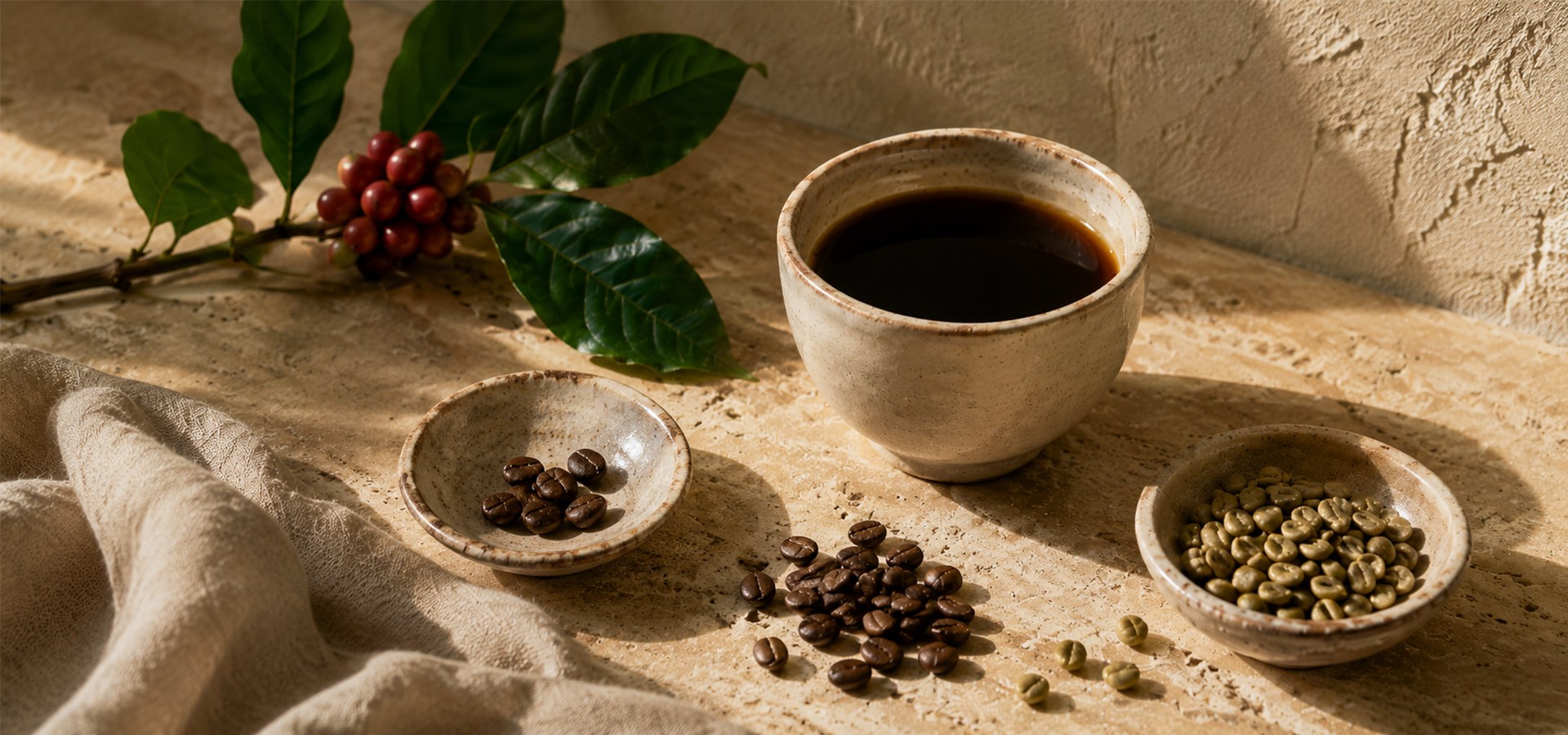
100% Arabica isn't a quality guarantee, it's a species label. We explain what it really means and what else defines a great coffee.
We see it constantly on bags, in cafés and on labels: 100% Arabica.
The phrase sounds almost like a guarantee of quality. But in reality, it says something much more specific: that the coffee comes exclusively from plants of the Coffea arabica species.
And that matters. Though it doesn't tell the whole story.
Arabica is a species, not a quality category
Within the genus Coffea there are numerous species, but two account for most commercial cultivation: Coffea arabica and Coffea canephora, commonly known as Robusta.
So when a bag says 100% Arabica, it means it hasn't been blended with Coffea canephora. It doesn't necessarily mean it comes from a single country, a single farm or a single variety: a 100% Arabica coffee can also be a blend of different Arabica origins or varieties.
And above all, being Arabica doesn't automatically make a coffee a good coffee.
Final quality depends on many other variables: the variety grown, farm conditions, fruit ripeness, harvesting, processing, green coffee storage, roasting and, finally, brewing. Research on sensory quality shows precisely that environmental and handling factors can meaningfully change the result in the cup.
So why is it emphasized so much?
Because Arabica and Robusta show real differences.
Generally speaking, Arabica coffees offer very diverse sensory profiles and can show acidity, sweetness, floral, fruity, spicy or chocolate notes, depending on the specific coffee.
Coffea canephora tends to have higher caffeine content than Coffea arabica and can bring more body, intensity and bitterness. Comparative studies have found chemical and sensory differences between both species, although there's enormous variability within each.
That last point matters: Robusta doesn't necessarily mean bad coffee either. There are high-quality canephoras, and there's growing interest in exploring their diversity and sensory potential. World Coffee Research notes, in fact, that the genetic diversity of C. canephora is considerably greater than that of Arabica and is still being studied.
What "100% Arabica" doesn't tell you
This might be the most useful part of the label.
Knowing a coffee is Arabica is information. But to really understand what's in front of you, it helps to look a bit further: origin, varieties, process, roast profile, roast date and the criteria behind how the coffee was crafted.
At ALGRÀ, that's exactly how we understand 100% Arabica: as a starting point, not the final word.
Because between two coffees carrying those exact same words on the bag, there can be two completely different cups.
And that's where it gets interesting.